




24 October, 1947; 9 am
The general bus stand of Baramulla had never been as crowded as it was on this windy day. It was busier than the idgah fair, except that the chaos was neither festive nor merry. Worried residents, anxious elders and young mothers cradling clueless infants bustled about with meagre belongings and solemn faces. There was a sea of people waiting to board buses to Sopore, to Rajouri, to Jammu.
As a rich cosmopolitan trade centre, Baramulla, they all feared, would undoubtedly be targeted by the fast-approaching plundering raiders, prompting several Hindu, Sikh and Christian families to escape to smaller, more distant towns, in the hope that they’d be safer there.
Amidst this crowd, two young girls stood facing each other under a metal awning. The roof of the green bus next to them was being loaded with bags and boxes.
“Some walnuts for you.” Zooni held out a cloth pouch to Gurmeet.”
“I got you some raisins.” Gurmeet handed her friend a packet.
“Think it over once again, Satnam.” Baba tried appealing to Gurmeet’s father one last time. “This is your home. Your ancestors’ home. Why must you send your family away?”
“We cannot sleep at night,” Satnam uncle pressed his eyes shut and let out a sigh. “Those Pashtuns from the frontier have reached Muzaffarabad … it won’t be long before they’re here in Baramulla. I hear they’re kidnapping girls. When I think of what they did to the women in Muzaffarabad …” his voice trailed off. “For their safety and for my sanity,” he stopped, and cast a loving look at Gurmeet and her sister. “I must send them away.”
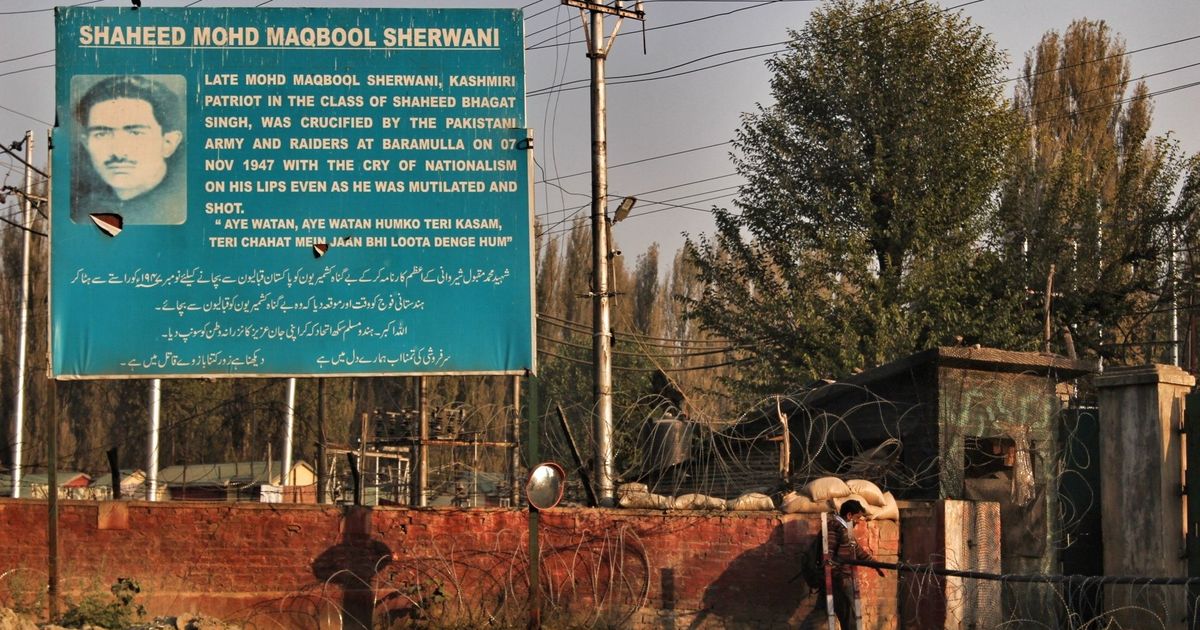
“But this is exactly what they want, isn’t it?” protested Maqbool boi, pointing to other families who had gathered at the bus stand, having fled their homes in a panic. “They want people to get scared and run away like this. So, they can grab their home and land. So, they can claim that Kashmir belongs to them. We have been neighbours for generations. Do you have no faith in us?”
Teary-eyed, the burly Satnam Singh took Maqbool boi’s hand and looked around at the many people from the neighbourhood who’d gathered for the send-off. Success or sorrow, festival or funeral, their families had tided through every triumph and turmoil as one. “Maqbool, my brother, I would never doubt you all. But these are strange times. You know how my cousins in Rawalpindi …” his voice cracked, “were burnt alive in their own homes. I just cannot take the risk …”
“As if your people didn’t kill our people in Amritsar …” retorted a voice from a bench behind them. They turned around to find a man dressed in a grey pheran, his face buried behind a newspaper.
Ignoring the jibe, Maqbool boi resumed his efforts to persuade Satnam Singh. “Do you not have faith in Sheikh Abdullah? In the Salamati Fauj volunteers of our party who have taken a vow to protect the people? Do you not have faith in kashmiriyat?”
“Do you not remember what the sheikh said when he was elected president of the National Conference?” added Hassan uncle. “He ended his speech by saying ‘India is our homeland … and it shall always remain so!’”
“Whatever anyone may say, the majority of Kashmiris are Muslim. Pakistan is our rightful home.” The man behind the newspaper spoke again. Two bystanders nodded in agreement.
“Ma, look – Masterji!” Zafran tapped Ma’s hand.
“Salaam walekum, Sapru sir!” several people greeted the stocky figure glumly approaching the bus, holding the hand of his teenaged daughter. Mr Sapru, Zooni’s favourite teacher, had lost his wife to tuberculosis a few years ago, and yet, he was always smiling and full of life. He’d greet every student by name, enthral them with his jokes and quote poetry in every second sentence he spoke. But today his forlorn eyes seemed to stare beyond all the familiar faces and greetings.
Suddenly, he gave an anguished wail, fell to his knees and brought his head to the ground. “Maej Kashmir! O Mother Kashmir!” he cried, and kissed the earth. “Forgive me for abandoning you. May you always prosper!”
And then, without another word, he got up and beckoning his daughter to follow, boarded the bus.
“Good riddance!” muttered the voice behind the newspaper. “Enough of these battas hogging all the wealth and jobs in Kashmir.”
“Have you got no conscience, mian?” Enraged, Budbab marched towards the persistent commentator. “Allah has given you a head, hasn’t he?” He pulled down the newspaper with his walking stick, then pointed his stick at the fellow’s black fez. “Don’t you care to use it to distinguish right from wrong? How will you defend yourself on Judgement Day?” he hollered.
“So, what do you suggest?” shot back the man, whom Zooni finally recognised as the tailor who owned a garment store in the market. He had a narrow face with deep-set light brown eyes. “That we continue to suffer under the maharaja? They’re a minority … these Hindus.” He glared at a nervous Pandit family preparing to board the bus. “Yet they hog the land, the jobs – everything! Are we to waste away our lives picking and packing apples?”
“Sheikh Abdullah has been fighting for our rights,” said Maqbool boi softly. “Things are improving. Democracy is coming to Kashmir. You need to have faith and patience.”
“And put yourself in the maharaja’s shoes for a moment …” said Budbab. He scanned the young faces in the swelling crowd. “I am no supporter of his, but in this instance, we have to give him some time. He wasn’t prepared for this attack!”
“The pathetic maharaja has no capacity to protect Kashmir from those marauders …” argued the tailor. “A year ago, the maharaja arrested Nehru for entering Kashmir, and now he’s busy pleading with him to send in the Indian army to rescue Kashmir. Are we street dogs to live on scraps and favours? We must take what is ours by right!”
“You know that the maharaja’s forces are on the back foot,” Maqbool boi contested sharply, “because many of his soldiers defected to the other side. Men like you who’ve sold their souls to the devil!”
“Quite right!” nodded Budbab. “And is there any greater shame than the fact that these vile men do what they do in the name of Islam?”
“So, should good Muslims just sit by and watch as their people in Poonch are hacked down by the merciless maharaja? When the raiders come, I say we open our hearts and our hearths to our brothers from the frontier – invite them in, throw them a feast!”
“Scum like you lecture others on being good Muslims – and you find takers!” said Baba sternly, fixing his glare on the tailor and his nodding companions. “That’s the greatest tragedy of these times!”
Tuning out the bitter adult banter all around her, Zooni’s tear-filled eyes followed Gurmeet into the bus and stayed on her friend through window after window as she made her way to her seat.
Excerpted with permission from The Battle for Baramulla, Mallika Ravikumar, Duckbill.
